Platform Features
Load testing built to break things at scale.
From a single endpoint to millions of concurrent users — VoltTest gives PHP and Laravel developers the tools to load test with confidence.
VoltTest is a performance and load testing platform for PHP and Laravel developers, powered by a Go engine delivering 275 req/s per virtual user and scaling to 10M+ concurrent users. Write tests with a native PHP SDK, integrate with Laravel via Artisan commands, and run locally or across distributed cloud regions with real-time P50–P99 latency metrics, error classification, and request sampling.
Performance
Blazing-Fast Go Engine
How fast can your load tests run?
Written in Go for maximum throughput with minimal resource consumption. Each virtual user runs as a lightweight goroutine — no thread pools, no JVM overhead, no per-VU memory bloat. Connection pooling and efficient HTTP handling let you simulate realistic traffic patterns without the infrastructure costs of JVM-based alternatives.
req/s per VU
per 1,000 VUs
max VUs
Developer Experience
Native PHP SDK
How do you write load tests in PHP?
Write load tests in the language you already know. No JavaScript, no YAML, no DSLs — just PHP with a fluent API that feels natural to any PHP developer. Define test scenarios alongside your application code, share validation logic, and run them locally or in the cloud.
- Fluent API for defining scenarios and steps
- JSON extraction and response validation
- Data providers for parameterized testing
- Works with any PHP project (Laravel, Symfony, vanilla)
Framework Integration
Laravel Package
How does VoltTest integrate with Laravel?
Deep Laravel integration with Artisan commands, automatic route discovery, and built-in CSRF token handling. Generate test stubs and run tests without leaving your terminal. Publish the config to customize behavior for your project, and use the --routes flag to scaffold tests from your existing route definitions.
- Artisan commands for generating and running tests
- Auto-discovers routes from your application
- Handles CSRF tokens and session cookies
- Publish config and customize to your project
User Journeys
Scenario Flows
How do you simulate real user behavior?
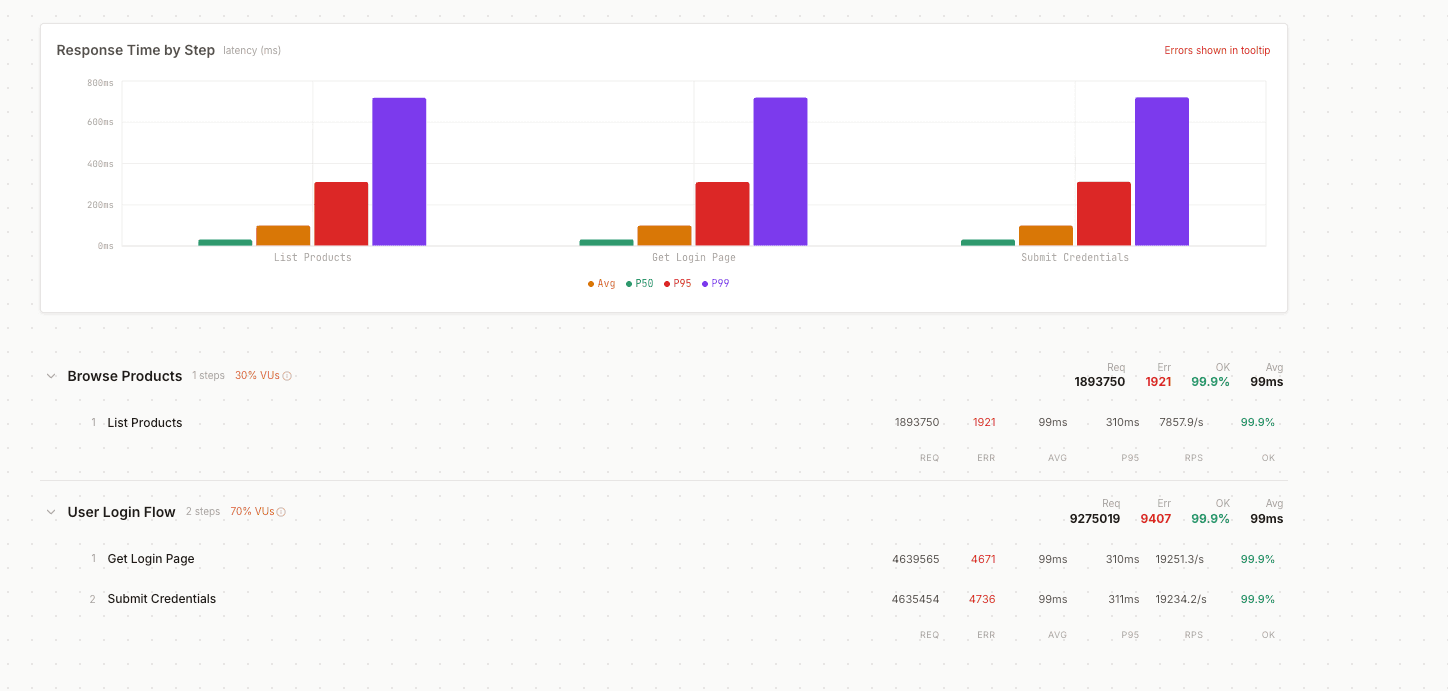
Model real user behavior with multi-step scenarios. Assign weights to simulate realistic traffic distribution — not every user completes checkout.
- Weighted steps simulate realistic drop-off
- Configurable think times between actions
- Data providers for dynamic payloads
- Chain responses between steps with extractors
Observability
Real-time Metrics
What can you monitor during a load test?
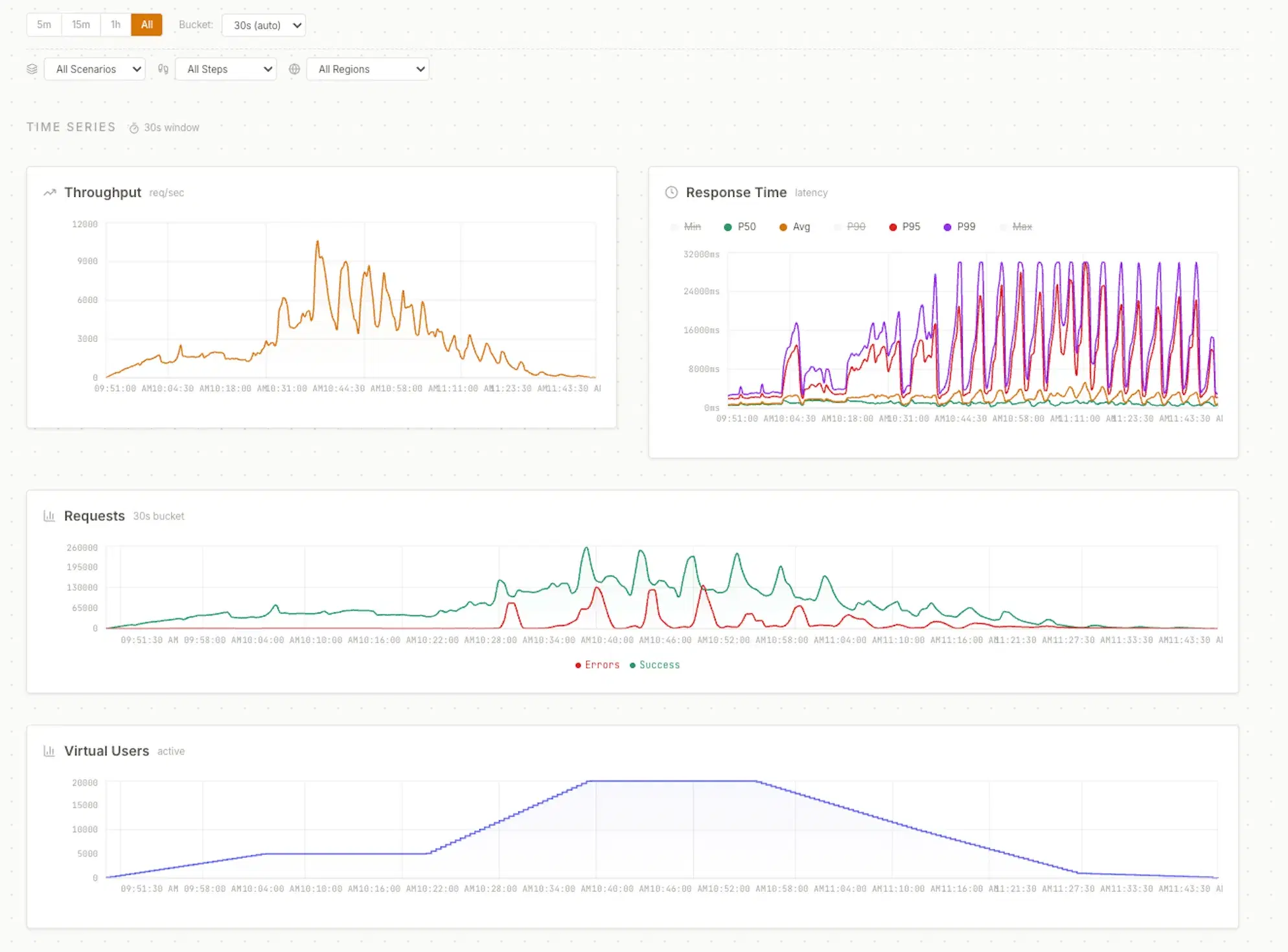
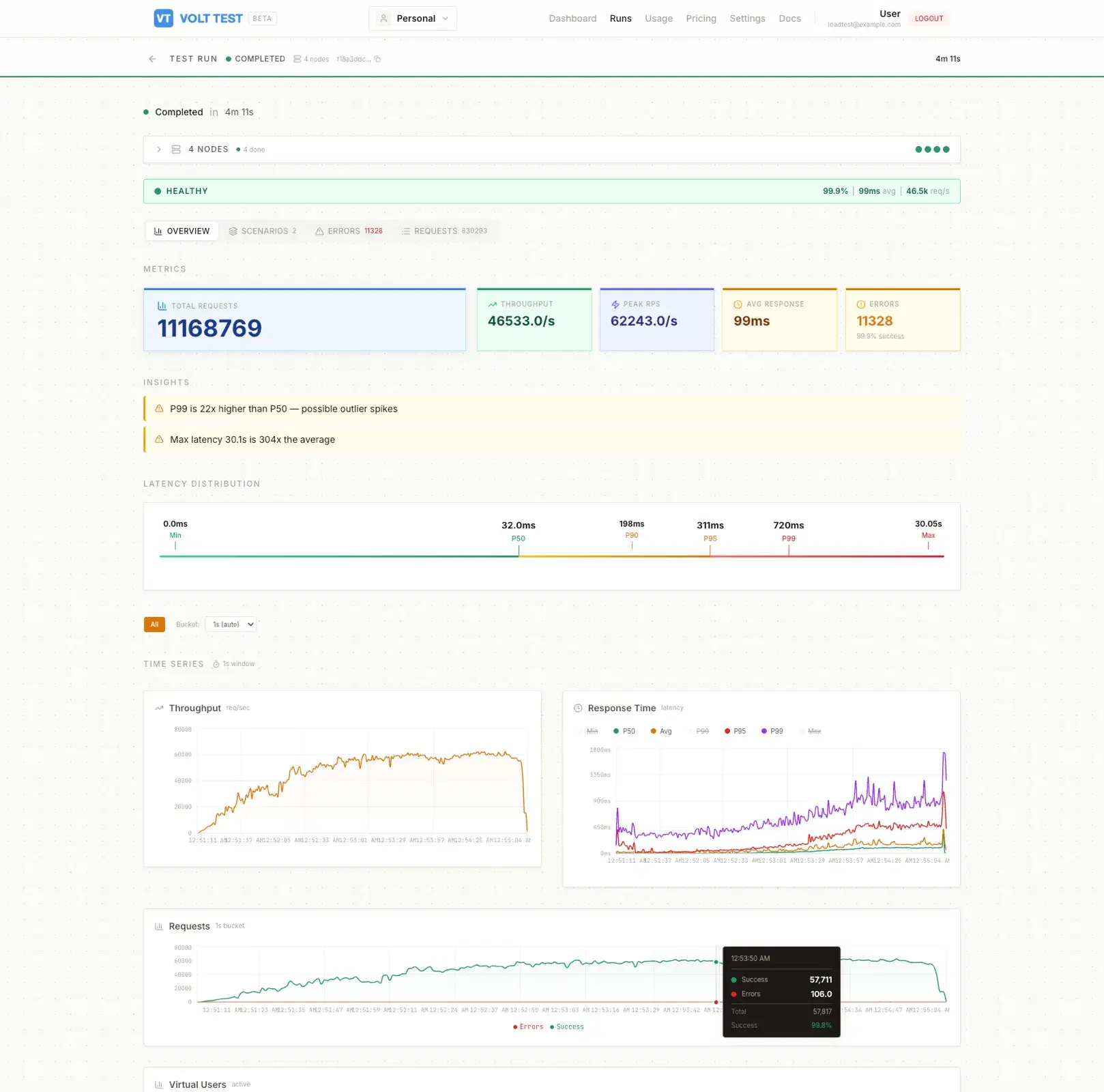
Watch your test unfold live. Throughput, latency percentiles, error rates, and virtual user count — all updating in real time with instant aggregation at any scale. Filter by scenario, step, or region to isolate performance bottlenecks as they happen.
- Live dashboard — 30s granularity, 1s when zoomed to 5 min
- VU ramp, throughput, and error time series
- Per-step and per-scenario breakdown
Analysis
Detailed Reporting
What does each test run measure?
Every test run produces percentile latency distributions, error classification, and request-level samples. Understand not just the averages, but the tail — where real users feel pain. Compare runs side by side to measure the impact of code changes, infrastructure updates, or scaling decisions.
- P50, P90, P95, P99 latency percentiles
- Automatic error classification by type
- Request sampling for debugging failed calls
- Run comparison for before/after analysis
Infrastructure
Distributed Cloud Testing
How does distributed load testing work?
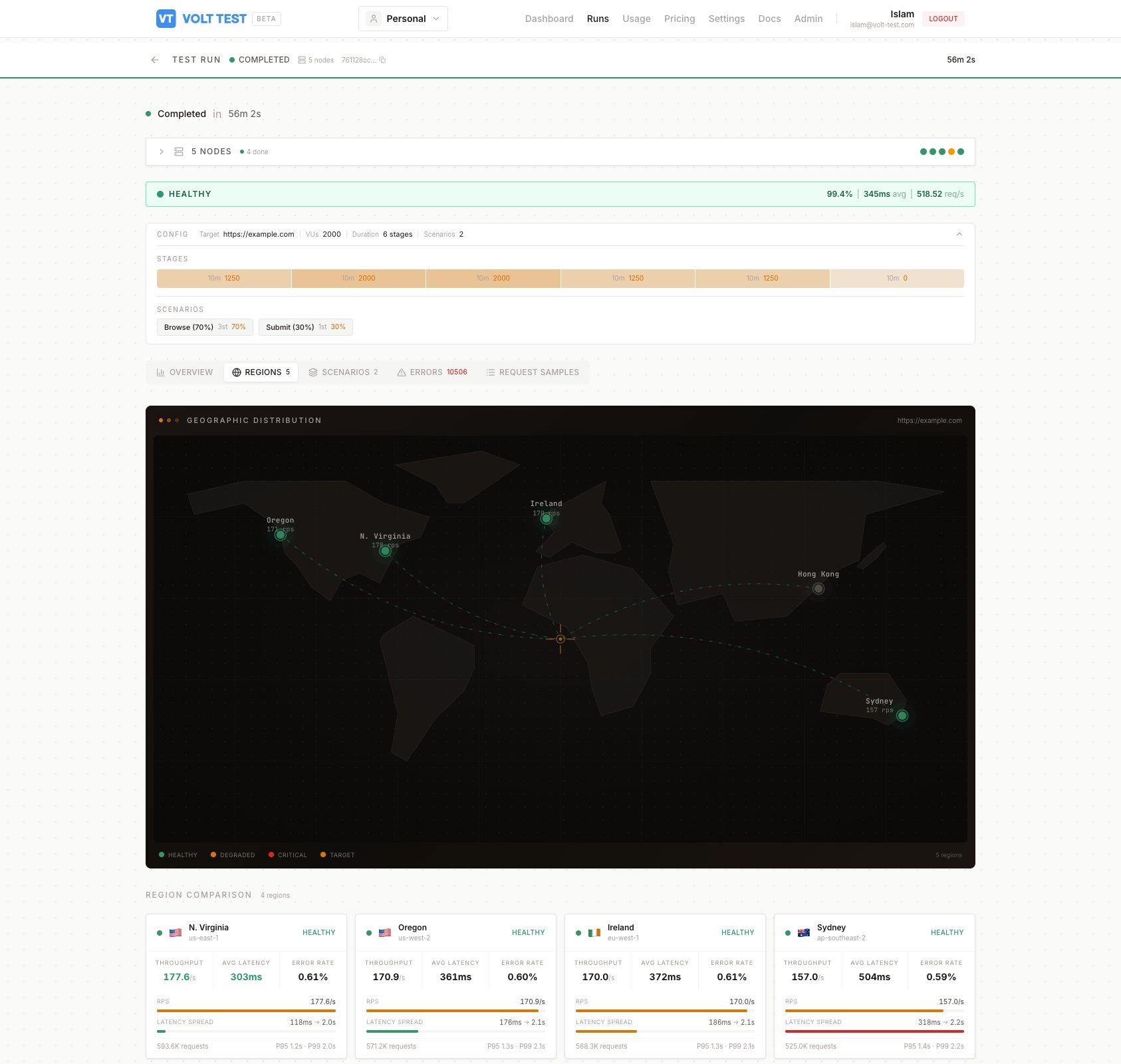
Tests run on real cloud infrastructure — not shared containers. Dedicated instances spin up for your test and tear down when done. Zero noisy neighbors. Generate load from multiple regions simultaneously to test how your application performs under geographically distributed traffic.
- Multi-region load generation
- Auto-provisioned and auto-destroyed per run
- Scale horizontally across multiple instances
Ready to push your limits?
Start with 500 VUs, real cloud infrastructure, and real metrics — no credit card required. Upgrade only when you outgrow it.
Free forever — 500 VUs, 10-minute runs, no credit card